On September 10, the 41st "Weiyan Dayi" Seminar — the 3D Sensing and Imaging Technology and Applications Forum — was held alongside the 27th China International Optoelectronic Exposition (CIOE). Lin Feng, Deputy General Manager of Fortsense, delivered a keynote address titled "RGBD-SPAD-SoC All-Solid-State Spatial Camera Chip Solution," publicly unveiling the company's latest progress in RGBD single-chip technology for the first time.
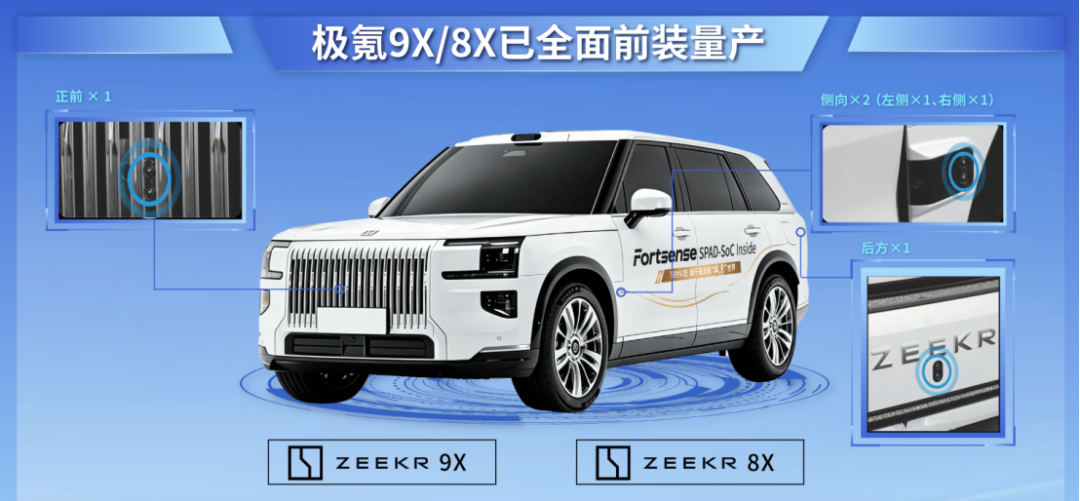
As an independent SPAD-SoC chip manufacturer, Fortsense is the industry's first to achieve large-scale mass production of automotive-grade all-solid-state LiDAR. With cumulative chip shipments in the hundreds of thousands, the company remains the industry leader. More vehicle models equipped with Fortsense's SPAD-SoC chips are expected to launch in 2026.
Human vision excels at perceiving color and texture but struggles with precise distance measurement. Cameras capture rich detail but cannot directly measure distance. LiDAR measures distance precisely but lacks color information. For Physical AI that must operate safely in the real world — whether intelligent-driving vehicles or robots — a perception-system failure can lead to a collision at extremely high cost. Their vision systems must therefore simultaneously capture accurate color, texture, and distance information.
The real challenge lies in how to fuse these data streams. Most mainstream solutions today use separate cameras and LiDAR for data collection, followed by back-end calibration and spatiotemporal alignment. This approach is complex, high-latency, and difficult to reduce in cost or size.
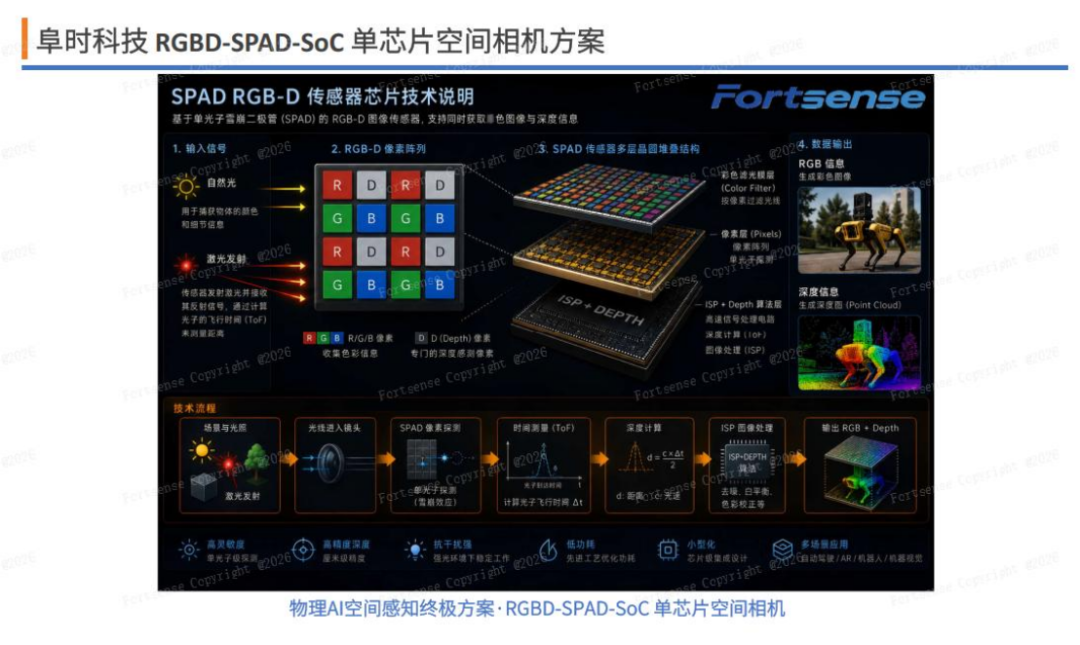
Fortsense's solution integrates color perception and distance detection into a single chip that natively and synchronously outputs RGB-D information: the single-chip RGBD-SPAD-SoC.
The RGBD all-solid-state spatial camera can directly reuse the optical path of a CMOS image sensor (CIS) camera. It requires only a single lens to synchronously acquire full-color RGB and distance information of the target area. The system has no moving parts, with digitally controllable integration time and uniform exposure across the field of view. Its reliability is essentially that of the chip itself, giving it significant advantages in lifespan, size, and cost. It is already widely recognized in the industry that the all-solid-state approach is the optimal solution for RGBD spatial cameras.
For downstream customers, there is another advantage: the overall architecture of the RGBD module is essentially consistent with Fortsense's existing all-solid-state flash LiDAR reference design. Most of the optical path can be reused, and engineering verification and mass-production ramp-up can proceed simply by replacing the chip, significantly shortening overall time-to-market.
Fortsense's RGBD-SPAD-SoC chip enables simultaneous RGB color sensing and dToF distance perception on a single chip. Backed by deep technological accumulation and long-term investment, this solution offers industry-leading time-to-market, with its core advantages resting on three key technologies:
1. In-house-developed SPAD devices: Using the latest process technology, pixel density is more than 4× higher.
2. In-house-developed composite filter technology: Enables simultaneous RGB color sensing and SPAD distance sensing on the same chip surface.
3. Multi-wafer stacking process: In partnership with a leading domestic foundry, the solution achieves two-to-three-wafer stacking. The upper layer handles color and SPAD sensing, while the lower layer integrates in-house-developed ISP and readout circuits, performing signal processing with differentiated exposure strategies.
Fortsense's RGBD-SPAD-SoC chip is currently undergoing intensive design, manufacturing, and testing, with samples planned for delivery and full mass production targeted for 2027. From deep technological accumulation to efficient engineering execution, Fortsense has already established an industry-leading position.
Fortsense's new-generation RGBD-SPAD-SoC single chip will initially target end markets such as intelligent driving and robotics. For robots in particular, precise registration between color and distance, combined with stringent constraints on low power consumption and small size, makes the single-chip RGBD solution the optimal choice. As Physical AI accelerates its deployment, demand for spatial cameras will surge.
During the forum and exhibition, multiple automotive OEMs, robotics companies, and module manufacturers visited to inquire about progress, focusing on sample availability timelines, resolution, and other key metrics. Fortsense plans to achieve full mass production of its RGBD chip in 2027 and welcomes supply chain partners to engage early for win-win cooperation.
For partnership inquiries: VIP@fortsense.com


Fortsense Co, Ltd
- Tel:0755-26907704
- Email:public@fortsense.com
- Address:Floor 44, Block A, Building 8, Shenzhen International Innovation Valley, Xili Street, Nanshan District, Shenzhen

All rights reserved © Copyright 2021Fortsense Co., Ltd.
Registration number:粤ICP备18121726号甘公网安备 62110202000092号